


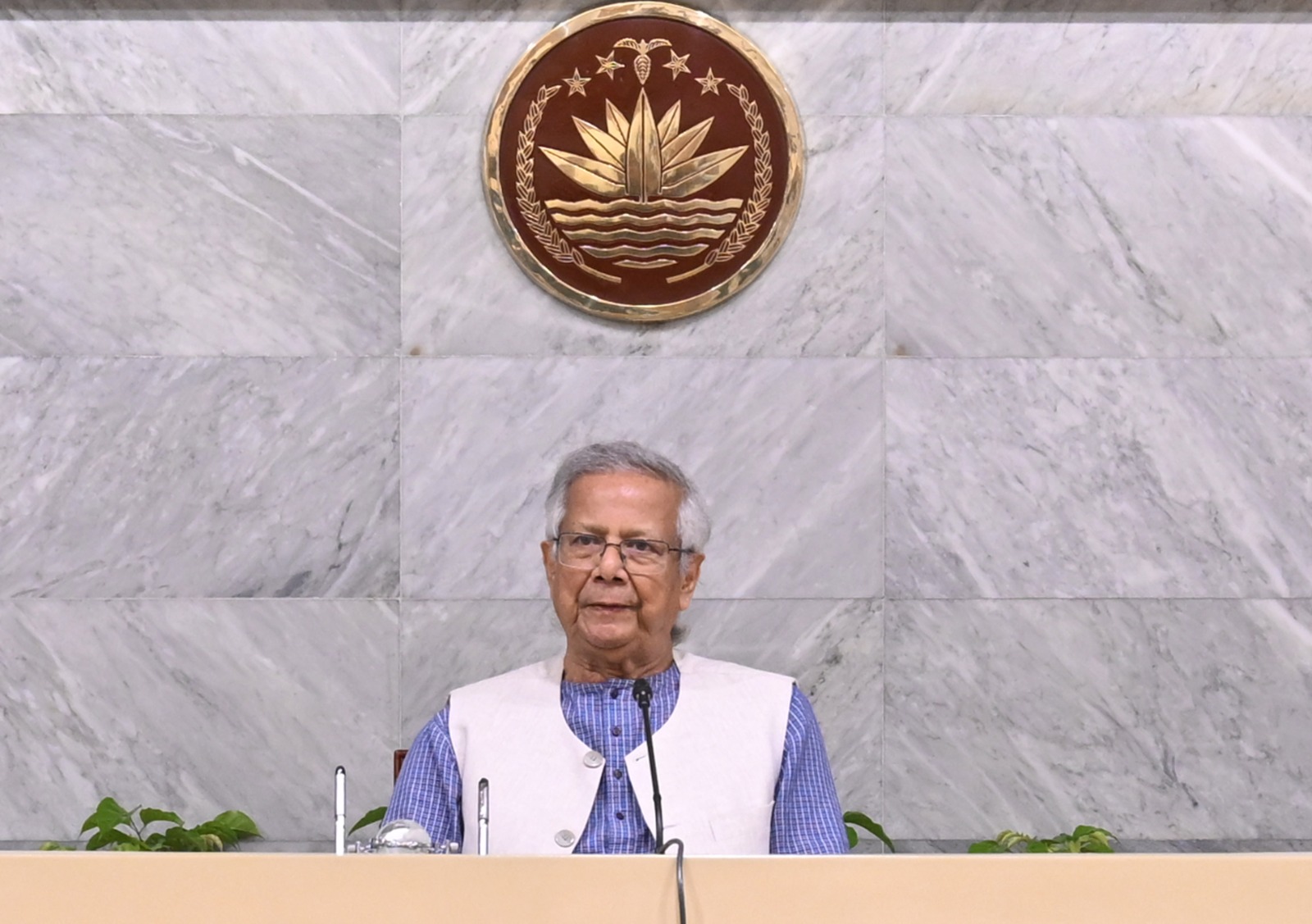
Chief Adviser Professor Muhammad Yunus on Monday urged the experts to provide written recommendations within the shortest possible time on the government’s required steps regarding earthquake preparedness.
“We want to act effectively and scientifically. Please submit your recommendations quickly in written form; the government is ready to take all necessary measures,” he said while presiding over an emergency meeting on earthquake preparedness.
The meeting was organised at the Chief Adviser’s Office (CAO) in the city’s Tejgaon area in the wake of several earthquakes last Friday and Saturday, said the Chief Adviser’s Press Wing on Monday evening.
The country’s top experts, researchers and university professors joined the meeting and gave their opinions on the issue.
The Chief Adviser said work is underway to form the required expert committee and one or more taskforces. “Works will begin immediately after receiving expert recommendations,” he added.
The experts at the meeting emphasised the importance of taking necessary precautionary measures instead of panicking over the recent earthquakes.
The experts emphasised the importance of taking necessary precautionary measures instead of panicking over the recent earthquakes.
Planning Adviser Wahiduddin Mahmud, Law, Justice and Parliamentary Affairs Adviser Dr Asif Nazrul, Disaster Management and Relief Adviser Faruk E Azam, Bir Protik, Power, Energy and Mineral Resources Adviser Muhammad Fouzul Kabir Khan, Housing and Public Works Adviser Adilur Rahman Khan, Environment, Forest, and Climate Change Adviser Syeda Rizwana Hasan, and the Chief Adviser’s Special Assistant Professor Ali Riaz attended the meeting.
Among the experts, MIST Professor Md Zainul Abedin, BUET Professors Dr Mehedi Ahmed Ansari and Professor Tahmeed Malik Al-Hussaini, Dhaka University (DU) Professor Md Zillur Rahman, Chattogram University (CU) Professor Dr Jahangir Alam, DU Professor Dr Humayun Akhter, BUET Professor Dr Tanvir Manjur, Bangladesh Meteorological Department (BMD) Acting Director Md Mominul Islam, meteorologist Md Rubyet Kabir, geologist Dr Reshad Md Ikram Ali, DU disaster expert Dr Md Shakhawat Hossain, DU Disaster Management and Vulnerability Studies Institute Director Md Moniruzzaman Khan and BUET Professor Israt Islam joined the meeting.
Speaking about the casualties in the recent earthquake, Professor Yunus said the deaths and injuries caused by the devastating earthquake a few days ago were a very tragic event.
“We must take preparations so that such incidents do not occur again,” he added.
“You have written in newspapers, given advice and shared experience. It is our collective responsibility to protect people from this panic,” the Chief Adviser said.
Please inform the government about the necessary actions in this situation. He added, "Tell us what preparations must be taken and in which areas awareness must be raised so that we can take all necessary prior measures no matter how the disaster comes."
Prof Yunus said expert opinion is needed on “what kinds of drills will be necessary” for earthquake preparedness and emphasised that the current state of the country’s preparedness must be evaluated.
He advised coordinating with Bangladeshi scientists and earthquake experts living abroad, saying local institutions working on earthquakes must enhance coordination with foreign institutions.
“We have developed an app named ‘Shubhechha’ for expatriate Bangladeshis. Use this app to connect with Bangladeshi scientists and experts abroad. The Chief Adviser requested feedback on potential additional features for the app.
The experts at the meeting said that many rumours have been spread on social media about earthquakes—such as claims that, "within 48 hours, within 10 days, within 1 month, a major earthquake will strike."
They stated that people are spreading such misinformation, despite the fact that no one can predict the exact timing of an earthquake.
The experts explained that while historical patterns of earthquakes in a region can help estimate timeframes based on frequency and magnitude, “specific dates and times cannot be predicted.”
Professor Dr Zillur Rahman said earthquake sources and origins must be reviewed to determine how many sources exist in and around Bangladesh and what shaking levels they may cause.
He said the probability of a major earthquake in Bangladesh is low, as it is a low seismicity region. “But we have to take adequate preparations,” said Prof Zillur.
DU Professor Dr Humayun Akhter stressed engaging young people in awareness efforts.
“Indoor, outdoor, individual and institutional—action plans must be developed at four levels and delivered widely. Using youth in natural hazard planning and technological initiatives will help everyone become mentally prepared, he said.
Professor Jahangir Alam said ministries can assess installations under their jurisdiction.
Special attention should be paid to hospitals, educational institutions and electricity and gas supply connections, he said, adding, Launching earthquake-related programmes in schools, colleges and universities will build awareness instead of spreading panic.
Professor Md Zainul Abedin emphasised creating awareness so the people don’t get panicked.
“We must work within our resources. More specific information must reach the public. We must educate people on the importance of maintaining composure. Open spaces and gathering points must be identified, and drills arranged accordingly. Drills in homes and educational institutions are essential,” he said.
The experts stated that hospitals must be evaluated for any shortages, the quality of their buildings, and their capacity to manage emergency situations, and that they should take necessary measures to ensure preparedness.
Public Works Department Chief Engineer (Civil) Md Khalekuzzaman Chowdhury said that using software, images of buildings with cracks caused by the earthquake are already being collected.
More than 200 buildings have been assessed so far, with most cracks found in partition walls, he said, adding, The software allows rapid assessment and necessary follow-up measures.
The meeting, however, decided that the government will briefly discuss the written recommendations sent by the experts and form a task force.
The task force, which will be formed to take immediate action on the earthquake, will include government and private officials and experts.


.jpg "Swapon calls for independent authority to verify journalist status")
