


The United States Embassy in Dhaka has warned that visitor visas must not be used for travel primarily intended for childbirth in the United States to secure citizenship for a child.
In a bilingual social media notice, the embassy said, "Using your visa to travel for the primary purpose of giving birth in the United States so that your child will have U.S. citizenship is not permitted. Consular officers will deny your visa application if they have reason to believe this is your intent.” An accompanying graphic added that applications would be refused if officials believe the main purpose of travel is to obtain US citizenship for a child through birth.
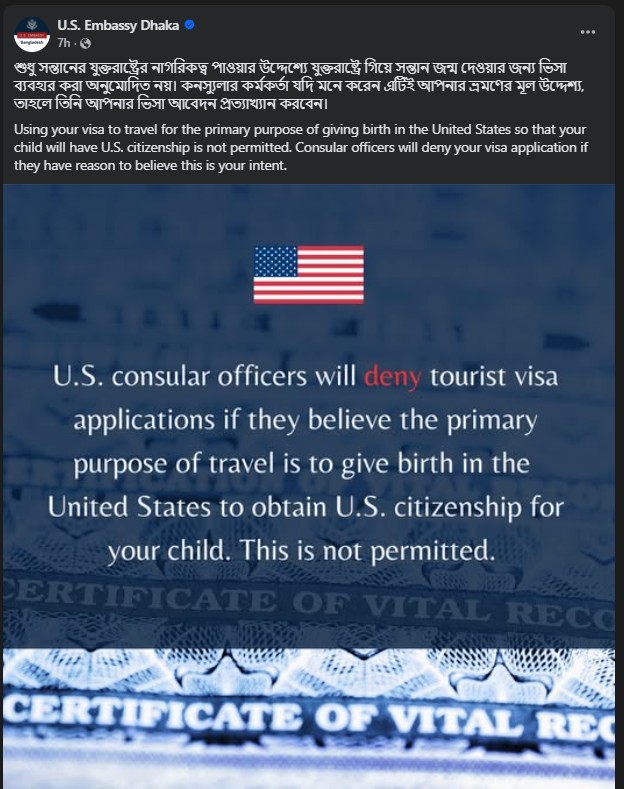
The embassy also shared the same message earlier on its verified X account, reinforcing the warning for visa applicants.
The guidance reflects existing United States visa policy and is not limited to Bangladesh. It applies to applicants worldwide, although the Dhaka mission issued the notice to clarify the rules for local applicants.
The United States Department of State says visitor visas, including B-1 and B-2 categories, are intended for temporary travel for business, tourism, or medical treatment. While tourism, family visits and business activities are permitted, birth tourism is not allowed under these visas.
Under a federal rule that took effect on 24 January 2020, consular officers must refuse a B non-immigrant visa if there is reason to believe the applicant’s primary purpose is to give birth in the United States to obtain citizenship for a child. The rule defines such intent as an impermissible basis for issuing a visa.
The regulation does not automatically prevent pregnant applicants from travelling. However, if a consular officer believes an applicant is likely to give birth during the visit, there is a presumption that the purpose of travel is to obtain citizenship for the child. Applicants can challenge that presumption by demonstrating a legitimate primary purpose for travel.
Those seeking medical treatment in the United States may be required to provide a diagnosis from a local physician, confirmation from a US medical facility, details of the expected duration and cost of treatment, and proof that all expenses, including travel and accommodation, will be covered.
The Department of State also requires applicants to show strong ties to their home country, evidence of the purpose of travel, and the intention to return after a temporary stay. Financial capacity to cover the trip may also be assessed during the visa process.
Officials warn that misrepresenting the purpose of travel can carry serious consequences. Attempting to obtain a visa through fraud or wilful misrepresentation may result in permanent refusal or denial of entry to the United States.
The embassy did not provide figures on how many applications have been refused on these grounds and did not announce any new visa measures. The notice signals continued scrutiny of applications where the declared purpose of travel may not reflect actual intent.
A US visa does not guarantee entry. It allows a foreign national to travel to a US port of entry and request admission, while United States Customs and Border Protection officers make the final decision on entry.
The issue is linked to birthright citizenship under the Fourteenth Amendment to the United States Constitution, which grants citizenship to individuals born on US soil. The 2020 rule does not alter that right but governs eligibility for visitor visas where childbirth is the primary purpose of travel.
.jpg "Ship recycling industry key to economy, employment: Muktadir")


-6a60a39f1f971.jpg "Outgoing Navy chief meets PM at Secretariat")


